Showing posts with label dieselpunk. Show all posts

Wednesday, July 30, 2014

Steampunk your home!

21 Cool Tips To Steampunk Your Home

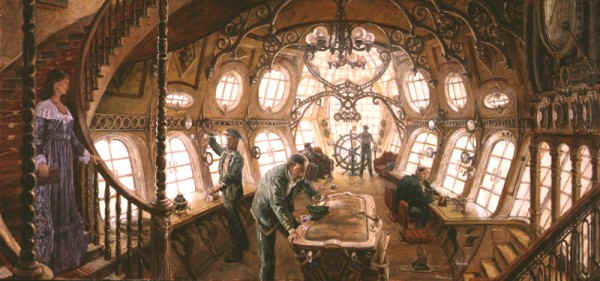
The steampunk style is not one of the most well known in terms of interior design. Maybe that’s because many of us don’t even know which are the basic details that define this concept. When I say steampunk, I remember about the Victorian era, with all the inventions back then, but the meaning of this word would be incomplete without the industrial details.
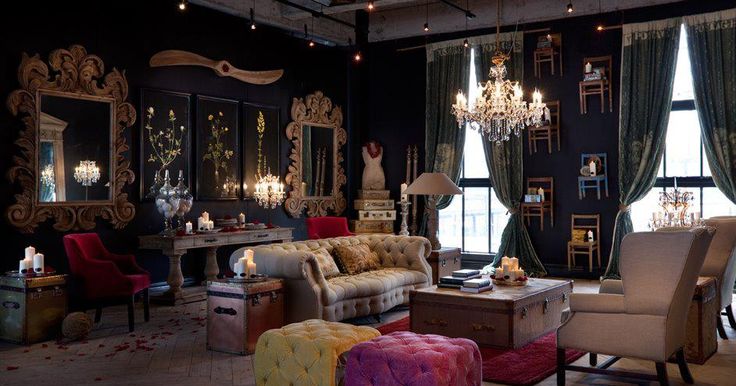
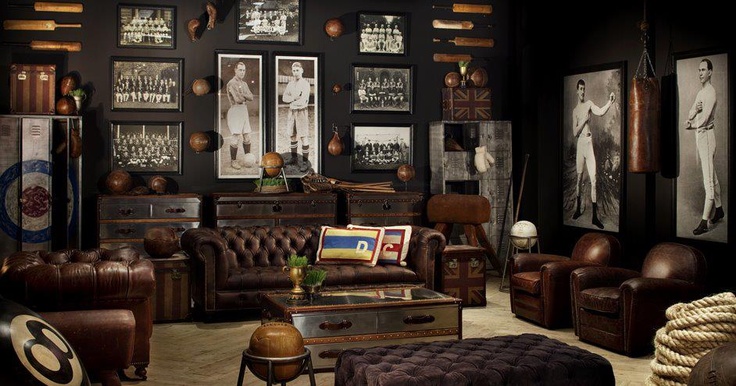

In essence, this trend is a mixture between elegant Victorian interior accessories and the strength of industrial elements. Maybe you remember about Joben Bistro, that beautiful pub from Romania. It’s an inspiration for us.

So, give your home a steampunk look with these awesome décor ideas and items!


1. Use muted neutral colors


Brown, sepia, cream, black, dark red and dark green, these are the most common colors used to describe this style. Choose one of them according to the room, or combine them if you want. Also, metallic colors should work.

2. Don’t be afraid to use refurbished furniture


It’s a fact that old furniture adds a special charm to any home. If you want to create a steampunk interior design don’t even think about buying new furniture, unless it’s specific to Victorian age.

3. Add an industrial touch with exposed bricks


Another idea will be to induce an industrial feeling by showcasing exposed bricks walls. If the structure of the building doesn’t allow you to do that, use wallpaper.

4. Decorate with old maps


Create awesome wall murals using old maps, or just frame some of them and hang them on your walls. Another idea is to decorate the lampshades with maps. The older, the better! You’ll love the result!

5. Buy a terrestrial globe (in case you don’t have one already)


Make sure it’s old and very used. It would be one of the most popular items in the house, and kids would love to spin it over and over again.

6. Expose leather items or furniture


Leather sofa and chairs are definitely a must for steampunk admirers. It’s one of the most important materials used to define this trend. Not only comfortable, but also elegant, this material increases the luxury level of your home.

7. Classy hats will bring elegance and style


Top-hats or bowler hats can be used to impress your guests. Because they are symbols of the Victorian era, they will easily become a part of your steampunk decor.

8. Victorian sewing tables


A Victorian sewing table always has a history and that’s why it will easily become a new source of inspiration for your visitors. If you don’ t have such a beautiful item in your home, try the antique stores.

9. Decorate your walls with gear wall clocks


Gears are important items of the steampunk culture, so don’t forget about them. Let your imagination run wild! A gear wall clock will certainly make a statement, but you can also use them to create and display industrial art pieces.

10. Use an old steamer trunk as a living room table


Sometimes you must improvise in order to obtain the desired result. If you don’t have a proper table for this kind of interior design, use a steamer trunk or any other suitcase to fill the empty space.

11. Use exposed framed herbariums


Sometimes we do our best to properly decorate the rooms of our house, but we forget about the entrance. Your hallway would never look more beautiful and sophisticated without those framed herbariums.

12. Decorate with sepia pictures


Create an antique effect by using sepia photos to decorate your walls. It’s your choice whether you use old pictures with your family, or with other places around the world.

13. Add some details by exposing technical and anatomical drawings


These kinds of sketches are highly representative for this trend. If you happen to have something like that among your personal things or you’re an engineer, don’t hesitate to use them.

14. Expose antique items like barometers, telescopes or typewriters


Victorians had a passion for inventing new tools and gadgets, and the best part is the fact that you can still find them in antique shops. Even though many of them are not functional, you can use them as decorating items.

15. Try textural contrast


You can create a steampunk interior décor if you manage to combine a hard material (leather) and a soft one, like lace. So, part of the appeal of steampunk is the juxtaposition of traditionally feminine and masculine elements.

16. Expose a Victorian dress, or canes, or helmets on the wall


Maybe some of you will consider this a creepy idea, but I think it’s worth a chance. Canes or helmets are also a good choice, and they are certainly easier to find in antique shops.

17. Don’ t forget about small wood jewelry boxes


Walk up to your local hardware store and buy some small metal pieces like gears, or screws or anything else that could be glued to the wooden box. You won’t regret this!

18. Use wallpapers with a Victorian pattern


If you don’t really like those, and you happen to be a talented painter, try something new: paint some creatures in the books of Jules Verne, or some mechanical installations you remember from Time Machine.

19. Display old books


Old books are a must in this case! Hard covered books are usually used, but paperbacks are also welcomed. Old notebooks with leather covers will also make a statement if they are tastefully arranged.

20. Create a metal pipe bookshelf


Industrial all the way, even when we talk about ideas to display your books! Steel pipes are elementary in industrial design and quite easy to handle. Here we have a special article about how you can recycle steel pipes. Have a look!

21. Add a chandelier


Light fixtures are always important. Through light you can easily emphasize the interior design of the room and even the furniture. If you have high ceilings, use a chandelier. Bring a little luxury and comfort!

Source: homedit.com

Wednesday, July 23, 2014

Heathrow's stairway to heaven!

Forget their sci-fi image: airships really could be the answer for Heathrow in a post-airport future, says Hawkins Brown’s Darryl Chen

Imagine the sky above London dotted with softly humming airships. Half floating, half jet-propelled, they make for a spectacle as familar and surreal as a dream. You recall the skies used to be streaked with vapour trails and resound with that delayed roar of aeroplanes? They’ve long been banished to somewhere in the estuary, while a new creature has taken its place over central London…

Fanciful? Not say manufacturers betting serious R&D money on airship technologies. Not say the UK government who have invested in airship development, or Hybrid Air Vehicles who plan commercial freight services by 2021. Airships are currently being deployed around the world for scientific missions, humanitarian efforts and even surveying natural disasters. The question of airships in the mainstream is not a matter of if but when.

Airships are becoming faster and quieter, they carry heavier payloads and, importantly, are carbon fuel-efficient. Current models emit 1/7 the carbon of a 787, with half the noise. Ballasts keep them stable in rough weather and they are filled with inert helium which is non-flammable. They benefit from vertical take-off and landing, and can dock in any small field with two ground staff.
Hawkins Brown’s airship port proposal

We have imagined they might take on some of the freight transportation were Heathrow to be decommissioned. The plan would consolidate logistics infrastructure already in place at Heathrow and in west London, and go some way to addressing the void of economic activity in the wake of the airport moving.

Airships will fundamentally alter the geography of distribution, in alleviating congestion on road and rail networks and in reaching both more remote and more built-up areas. (Could this be the lifeline to the north that HS2 is mooted to be?) Some 920 million parcels were dispatched from UK e-retailers in 2013 making Britons the biggest online shoppers in the world. The smooth distribution of goods underpins modern life. It underwrites our material securities. This is the stuff urbanism is made of.

Sure, we should be consuming less. But as long as we are consuming, let’s do it greener. Low carbon-emission airship freight might form an ethical brand, comparable to fairtrade or organic. A cost premium can be added at the point of sale when dealing in comparison goods. And let’s not forget that if we’re still in the EU then they will increasingly be on our back about enforcing emissions cuts.

If airships are the whales, then drones are the mosquitoes. What other creatures will inhabit this airborne ecosystem of the near future?

Source: bdonline.co.uk

Tuesday, May 27, 2014

Rebels Market - The Alternative for Steampunks!

RebelsMarket Launches First International Alternative Marketplace - a Home for the Fashion Rebels to Buy & Sell Alternative Inspired Items

"What makes RebelsMarket interesting is being able to offer the fashion rebel an international marketplace carrying curated goods from coveted underground brands and independent sellers . Our style is influenced by the edgiest of fashion from Goth to Emo."

RebelsMarket - an international marketplace carrying curated goods from coveted underground brands and independent sellers. Our style is influenced by the edgiest of fashion -- from goth to burlesque, from tattoo to steampunk.


Los Altos, California (PRWEB) May 12, 2014


RebelsMarket.com has launched the first alternative-inspired online marketplace and community for the anti-mainstream and fashion-forward. The site caters to individuals with unique interests in different fashion subcultures, including glam goth, punk, street, emo, rock, skate, steampunk, burlesque, fantasy and tattoo.

With co-founders hailing from Kenya, Germany and the U.S., RebelsMarket offers international goods from antiestablishment and indie brands. According to co-founder Robert Wagner, the idea stemmed from his personal experiences growing up as a self-proclaimed rebel. He refused to accept what was socially acceptable and instead preferred a more edgy and rebellious lifestyle. After launching a tattoo-themed Facebook page and gaining 4 million “likes,” he knew there was a large, underserved counterculture fan base who would value a marketplace to buy and sell edgy, alternative items.

RebelsMarket provides sellers from all over the world with the opportunity to create free online storefrontsand charges a 15-percent transaction fee once an item is sold. Vendors can connect with a niche audience of subculture fans in search of hard-to-find unconventional products. Featured sellers include Tattoo Fast Online, Steampunk Retro, Kate Clothing and InkAddict just to name a few. Since its inception in 2012, RebelsMarket has realized 45 percent growth month over month.

Some of the trending items on RebelsMarket include avant-garde layered cardigans, leather wristbands, journals,tattoo, goth, vintage clothing retro messenger bags, temporary tattoos and more. RebelsMarket also features a blog which highlights new fashion - from rebellious looks to edgy street style and makeup techniques, interviews with sellers and subculture trend pieces.


Source: prweb.com

Sunday, May 18, 2014

Steampunk video game....come to life!

"Forevertron Is A Strange Steampunk Video Game World Come To Life"

A few miles away from the Wisconsin Dells stands the Forevertron, one of America's strangest roadside attractions.

Forevertron was built by Tom O. Every, a British born Wisconsinite who worked in the salvage and wrecking business. In 1983, Emery renounced his former name and assumed a new identity as Dr. Evermor. According to Emery, "I became Dr. Evermor around 1983 when we started to build the Forevertron outside of Baraboo, Wisconsin. I was a bit upset with the world, not so much the economic conditions as the judicial system and things like that, and I wanted to perpetuate myself back into the heavens on this magnetic lightning force field."


Every concocted a complex backstory for Dr. Evermor, detailed in a PBS Independent Lens article:

"Dr. Evermor was a slightly eccentric Victorian-era professor-inventor from Eggington, England. As a child, Evermor had been trapped in a huge electrical storm with his father, a Presbyterian minister. Such a storm, his father said, could only come from the hand of God. This event made a big impression on the future doctor. From that day forward, Dr. Evermor knew what he had to do. He would move to Wisconsin and from relics of the industrial age, he would build the Forevertron. This circa 1890s spacecraft would be his salvation."

Starting in 1983, Dr. Evermor started to accumulate junk and salvage from industrial sites and - without any blueprints or engineering experience - began crafting the giant Forevertron he claimed would one day transport him into the skies. He also populated the grounds with increasingly strange and complex metalwork creatures that wouldn't be out of place in a particularly eccentric Japanese RPG. The grounds are a close approximation of a steampunk fan's greatest fantasies come true.

I was lucky enough to be in the Baraboo area last summer, and went visited the Forevertron at a friend's urging. It's an amazing place. The scale of the Forevertron itself is impressive - it stands between two and three stories tall. The gates are open; there are no tour guides, no one trying to sell anything. As I wandered around the grounds, I couldn't help but feel transported into the world of
a video game. If you're ever close, I highly recommend you go. The following are some pictures I took, along with a large panoramic view of the Forevertron. I've also included a brief video walkthrough I took with my phone. It's not of the highest quality but gives you an idea of the scale.


Source: gameinformer.com

Saturday, May 17, 2014

Steampunk Subgenres...

Extolling the Virtues of Steampunk Subgenres
- by Miss Alexandrina


Yes, WTCB is more NeoVictorian than Steampunk – rather than being set in the 19th Century, NeoVictorian or ‘Victoriana’ novels are set in the modern century with Victorian manners, class systems and technology as I hope WTCB is, whilst being set in 2010 – but with the devising of my new Steampunk novel ‘H’, I’ve realised how comfortable I feel in a world surrounded by the tautness of order and rules, a la the Victorian era. I don’t see what is too much of a problem by putting on a ‘steamsona’, a ‘steampunk-person’; following the rules of late 1800 and early 1900 in a modern world can actually be intriguingly healthy.

But Steampunk is so wide that, like any cross-curricula genre, one can dive into so many different subsets and interpretations.

The term is not about proscriptive designing of worlds, but about how one lives what might have been. Alternate past, after all. Hence I ask: what does Steampunk mean to you?

Is it an art? Well, everything is an art (arguably, though one might suggest that every art is a science of using logic…but I shan’t get into that here. That thought is for the other blog.) – but is your Steampunk a visual art? Is it in the creative notions, the way one devises not only the worlds of dirigibles, clockwork (like the table-clock on the blog-bar above) and torn power of guns and rough-style in conceptualisation, but also in paintings with characters looming in a Steamy sky. It may be a talent I lack, but I have seen some gorgeous artwork online.

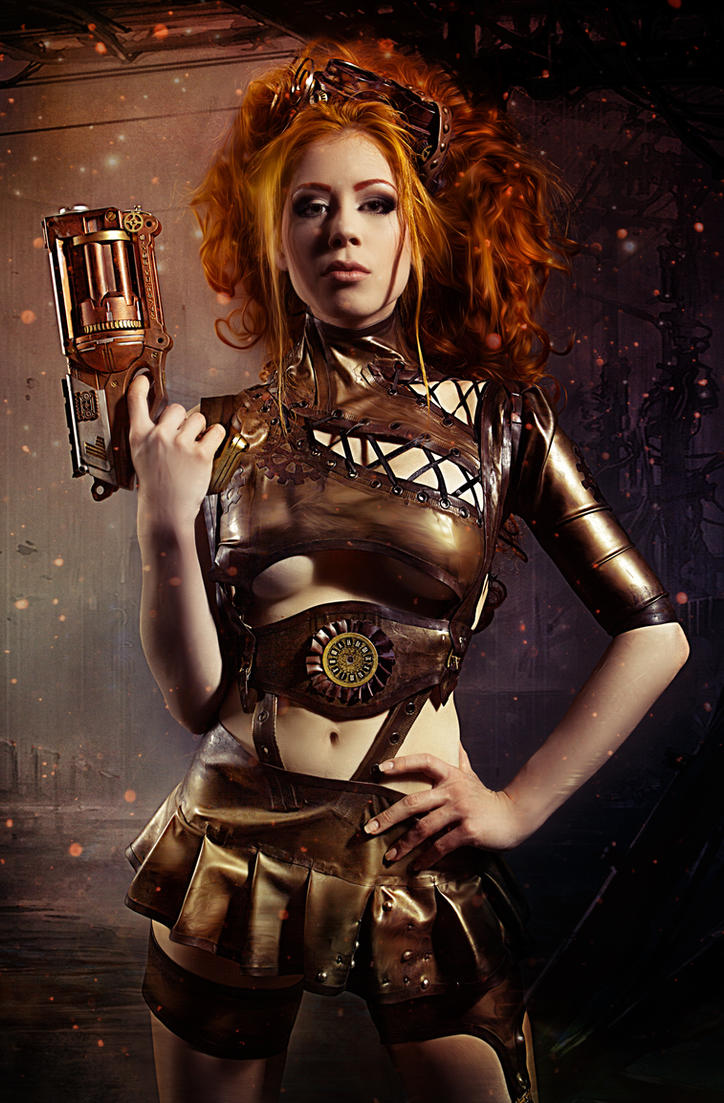
The majority of the top Google images for ‘steampunk’ are of women holding guns and wearing very little, but mostly leather and iron. Personally
, I disapprove.


Is it a craft? Is your Steampunk in the act of changing mechanical bits-and-bobs into touchable decorations? Because of its growing trend, Steampunk shops (especially those on Etsy) have sprung up with trades – just as those shoppeswould have by trade in the true century.

Steampunk is a lifestyle for some. As well as writing, Steampunk extends to music (and film and popular culture, etc). Far be it for me to list how Steampunk has been influenced by the cultures and its own budding subgenres, but one definitely sees Steampunk changed by whom is its author. Some people of colour create focuses and characters of colour and settings that include dashes of their culture as it might have been in the ‘East’ in a Steampunk past; some British authors use their own knowledge of manners and make that one of the core values of Steampunk. Of course, that’s great – a universal community from one idea. Perhaps because the genre of Fantasy centres on a purely speculative past, those who were treated with scorn in the real past get a chance to live more freely in the Steampunk one.


Although it’s not a route into which I like to venture, some Steampunk depicts a barren land and a cast of Western-esque characters, steam pistols and leather utilities at which the everyday Victorian might pale, with tough, angular styles seen more in gothic fingerless gloves than classic royalty elegance. “Endless prairies of the North,” as described in Paul Shapera’s New Albion I track of The Dolls of New Albion opera.

What does it mean to me? Fashion, but not in a superficial way: dressing in an appropriate way, complete with the historical requirements. I’m not a fan of Steampunk representations of ladies with external corsets and higher-than-ankles (or, at a push, knee-and-higher) dresses. Even if the alternate past accepts this sort of anachronism, to me it jars with what would show the era as it is.

There’s a difference between an autostat, a zeppelin and a dirigible, you know, and these details add colour to one’s choice of type of Steampunk. I prefer the latter, myself, with its traditionally navigable quality (I hear your raised eyebrows: of course the linguist chooses the etymological definition: ‘dirigible’ was originally French for steerable), implying that the use of coal/steam to fly has sense in power, despite its non-rigidity. That opinion might be questioned by the traditional use – as opposed to the traditional meaning – but I’m certainly allowed to twist the proper past a little ;)

Too, as Lord Pikedevant, Esq. has sung, Steampunk is not so much cogs as mechanisms, not so much dress as attitude. Steampunk – for me – is as much about the way one holds one’s self and speaks and treats others as what one looks like. And, you know, the cogs have got to work. In the Victorian and progressive Industrial age, every piece of technology had a role to play and affected everyone on a near-daily basis. Whilst there are some great concepts in the land of Steampunk art, some simply don’t intrigue me because they clash with my understanding of ‘Steampunk’ as a working society tag.

And that’s all right, because the Steampunk world varies depending on its creator.


Source: missalexandrinabrant.wordpress.com

Wednesday, May 7, 2014

Steaming through the Hills....

"Historic steam engines will be snaking their way through the hills to the delight of spectators."


The Wirksworth Assessment Trial will take place on Saturday, May 17, involving more than a dozen road steam engines dating from between 1875 and 1930.

The trial will set off from Ecclesbourne Valley Railway, in Wirksworth, at 9.30am, the engines will climb up Wash Green and down Long Way Bank to the A6.

Continuing along the A6, they will turn left at Ambergate onto the A610, preparing for the left turn at Bull Bridge Hill, up into Crich. They will reach Crich Tramway Museum at lunchtime, before heading off to Lea and onto Tansley and Matlock.

They will go through Matlock Bath and up Cromford Hill, before parking up at the Lime Kiln, in Wirksworth, at about 4pm.

Helen Debes, one of the organisers, said: “As engine owners, we don’t meet up and road the steam engines on the road around a set route. The Derbyshire Dales were chosen as there is stunning scenery, the Derwent Valley Mills world heritage site, and its central location.”

Source: derbyshiretimes.co.uk

Thursday, May 1, 2014

Politics of Steampunk

"A debate which has been going on for quite some time: The politics of steampunk - in a world full of mad scientists, airships and class."


By Rjurik Davidson 4.Jun.12

The subgenre of Steampunk – that subgenre of speculative fiction set in a fantastical Victorian era filled with airships, mad scientists and mechanical replicas of people or animals – may well have reached its zenith. With the new Sherlock Holmes movies, The Golden Compass or Scorsese’s Hugo, it seems possible that the initial burst of zest and inspiration will now settle into a more subtle ticking over of novels and films as the subgenre colonises the cultural spaces still open to it (Heart of Darkness steampunk? Opium-war Steampunk?).

For some time a debate has been raging about the politics of the subgenre.

For some, Steampunk is a reactionary nostalgia for past that never happened. In a review last year, author and critic Adam Roberts claimed that Steampunk is a perfect example of Jameson’s claim that the culture of postmodernism means a loss of any sense of historicity. For Roberts, Steampunk is ‘a studied dismantling of the consecutiveness of history in the service of a particular set of styles and fashions.’ He continues:

the appeal of the genre is in the way it finesses the past into the present. This is an aesthetic strategy it shares with Heroic Fantasy (or much of it) as a mode: a disinclination to encounter the past as past. Most twenty-first century representations of a notional “past” are based on the idea that people in the nineteenth century (or, in post-Tolkienian Fantasy, the middle ages) were basically people exactly like us, and therefore people with whom it requires no effort from the reader to identify.

According to Roberts, Steampunk jettisons a sense of the logic of history. Fundamentally, the subgenre is an irrationalism.

Others have mounted similar arguments. A couple of years ago, science fiction author Charles Stross claimed on his blog that most steampunk refused to face up to the Nineteenth Century as it really was. In that world, Stross claimed:

Life was mostly unpleasant, brutish, and short; the legal status of women in the UK or US was lower than it is in Iran today: politics was by any modern standard horribly corrupt and dominated by authoritarian psychopaths and inbred hereditary aristocrats: it was a priest-ridden era that had barely climbed out of the age of witch-burning, and bigotry and discrimination were ever popular sports: for most of the population starvation was an ever-present threat. I could continue at length. It’s the world that bequeathed us the adjective “Dickensian”, that gave us a fully worked example of the evils of a libertarian minarchist state, and that provoked Marx to write his great consolatory fantasy epic, The Communist Manifesto. It’s the world that gave birth to the horrors of the Modern, and to the mass movements that built pyramids of skulls to mark the triumph of the will. It was a vile, oppressive, poverty-stricken and debased world and we should shed no tears for its passing (or the passing of that which came next).


Evan Calder Williams makes a different point in his book Combinded and Uneven Apocalypse. For him, steampunk is a ‘weak handmaiden of Obama-era capitalism.’ That is, he periodises steampunk according to the conjuncture, much as China Miéville once periodised the ‘New Weird’ according to the development of the anti-globalisation movement. For Evan Calder Williams, the promise behind steampunk is to ‘keep technology, keep consumption, but make it “thoughtful,” make it responsible, make it “sustainable.” All in all, a participation in that great pastime of the pseudo-Left, remembering the era that never was, back when life was simpler and labor was meaningful.’

But if there is a strong current of left critiques of steampunk, there are also those who defend it. In response to Roberts, Jeff Vandermeer, co-writer of The Steampunk Bible and co-editor of the anthologies Steampunk and Steampunk Reloaded, claimed that these sorts of readings were selective. Vandermeer wrote to Roberts that:

you’ve basically defined a subset of steampunk in your analysis rather than the totality of it, that you’ve decided to focus on one small cog in terms of the mindset behind it, I hope you’ll understand that the impulse to defend something that alas from the term itself *seems* intended to be nostalgic comes from somewhere decidedly *non-escapist*. This isn’t from any particular special love for steampunk fiction or from writing it myself – I don’t – but from simply having had to exhaustively document it and the whole creative subculture.

This response has two aspects to it. The first is a purely material objection: many of the works of steampunk don’t fit the claims of its critics. The second is that as a result, these critics get the definition of steampunk wrong. What is interesting is the way that this debate echoes an earlier debate between advocates of science fiction and those of fantasy. For many of the early critics of the genres, science fiction was a progressive form and fantasy the reactionary one. Science fiction was forward looking, a literature of ‘cognitive estrangement’ as critic Darko Suvin famously defined it, a way of rational thinking. It made you consider the way the world of the story worked (the cognitive side of the definition), the rules of the social structure, if you like, and this made the reader reflect back on our own world. If you present a world without sexism or racism, this naturally makes the reader ask, ‘what causes these discriminations in our world?’

According to these critics, fantasy was instead irrationalist; for Suvin, it was a ‘sub-literature of mystification’. It didn’t operate according to the rules of science (either social or the ‘hard’ sciences). It was obsessed with the return to a romanticised neo-feudal world, in which the highest political aspiration was to be ruled by a benevolent ‘king’, be that Aragorn or the kitchen-hand who, unbeknown to himself, was deposed by an evil lord and is yet to realise his destiny. We can be sure that by the end of the series, the king will be restored to his throne, order will be reinstituted (with everyone in their place) and everything will be right with the world.

But this long-accepted critique was blown apart by writers of the ‘New Weird’, another subgenre of speculative fiction who (recalling the writers of the 1930s) broke down the boundaries of science fiction and fantasy. China Miéville’s books were probably at the forefront of this, but just as important was the introduction he wrote for the journalHistorical Materialism’s symposium on fantasy. For Miéville:

The usual charge that fantasy is escapist, incoherent or nostalgic (if not downright reactionary), though perhaps true for great swathes of the literature, is contingent on content. Fantasy is a mode that, in constructing an internally coherent but actually impossible totality – constructed on the basis that the impossible is, for this work, true – mimics the ‘absurdity’ of capitalist modernity.

Indeed, for Miéville, the fantastic is embedded in contemporary capitalism, both in the ways that commodification works and in the way that the human imagination is part of the productive cycle. Real life under capitalism is a fantasy.

Moreover, for Miéville, fantasy can have exactly the same ‘cognition effect’ as science fiction. A fantastic novel about class, race or sexuality might have greater insight into contemporary reality as a novel about the bickering of a middle-class family isolated from great social struggles. In other words, fantasy can be just as good to think with as science fiction. But it depends more on the work itself rather than the specific form.

These arguments seem to me to be true also of steampunk. The point is not so much the ‘content’ of the fiction, but rather the attitude of the work to its own content. Just as one can write a nostalgic view of the Victorian era from the point-of-view of the aristocracy, so one could write a critical view from the point of view of marginalised. Steampunk, like many cultural forms, is a thus site of struggle. The real divisions lie not between genres, it seems to me, but across them.

Source: overland.org.au